

Why AI Depends on Business Intelligence, Not Replaces It
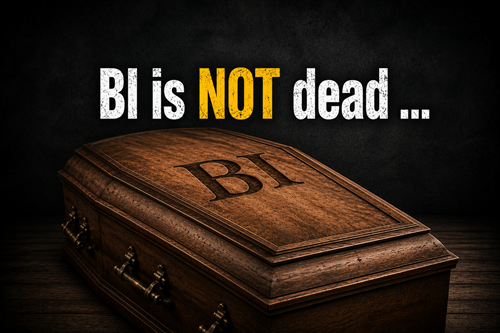

The "AI will replace Business Intelligence" narrative has been building for years. Silvon Software's analysis makes a compelling case for why it's wrong — and why the rise of generative AI actually makes BI more important, not less.
The Core Argument
Here's the part that surprises most people: AI doesn't replace BI. It depends on it.
The organizations getting the most value from AI aren't abandoning their BI platforms — they're building AI on top of strong BI foundations. Generative AI makes data more accessible. But accessibility is not the same as understanding.
An AI chatbot can answer "Why did gross margin decline in the Northeast last quarter?" — but only if someone has already established what "gross margin" means, which systems contain the data, how regional hierarchies are defined, and who has permission to access what. That infrastructure is Business Intelligence.
The "AI Talks to the Data, It Doesn't Think About It" Problem
Generative AI tools predict statistically likely responses based on patterns. They don't understand corporate definitions, governance policies, financial controls, or operational nuances. As Silvon puts it: "AI might talk to the data, but it doesn't think about the data."
What BI provides that AI can't replace:
- Data governance — ensuring consistent definitions across departments
- Trust — the reason decision-makers actually act on numbers
- Business context — KPIs, metrics, and rules designed by people who understand what matters
- Lineage and auditability — knowing where data came from and how it was transformed
Why AI Makes BI More Critical
The more accessible AI makes data, the more important it is that the underlying data is governed and trustworthy. Silvon cites research showing organizations don't gain value because AI generates answers — they gain value when users trust those answers enough to act on them.
Many AI initiatives are failing not because of the AI, but because of poor data quality, inconsistent definitions, and fragmented systems — the same problems BI has spent decades solving.
The future isn't AI instead of BI. It's AI powered by BI.
🔗 Read the full article on Silvon Software
Stay in Rhythm
Subscribe for insights that resonate • from strategic leadership to AI-fueled growth. The kind of content that makes your work thrum.
More from Thrum
Additional pieces exploring adjacent ideas