

The Seven Stages of AI Proficiency Every Marketer Needs to Understand

I've been watching marketers struggle with AI adoption for the past year. The pattern is consistent.
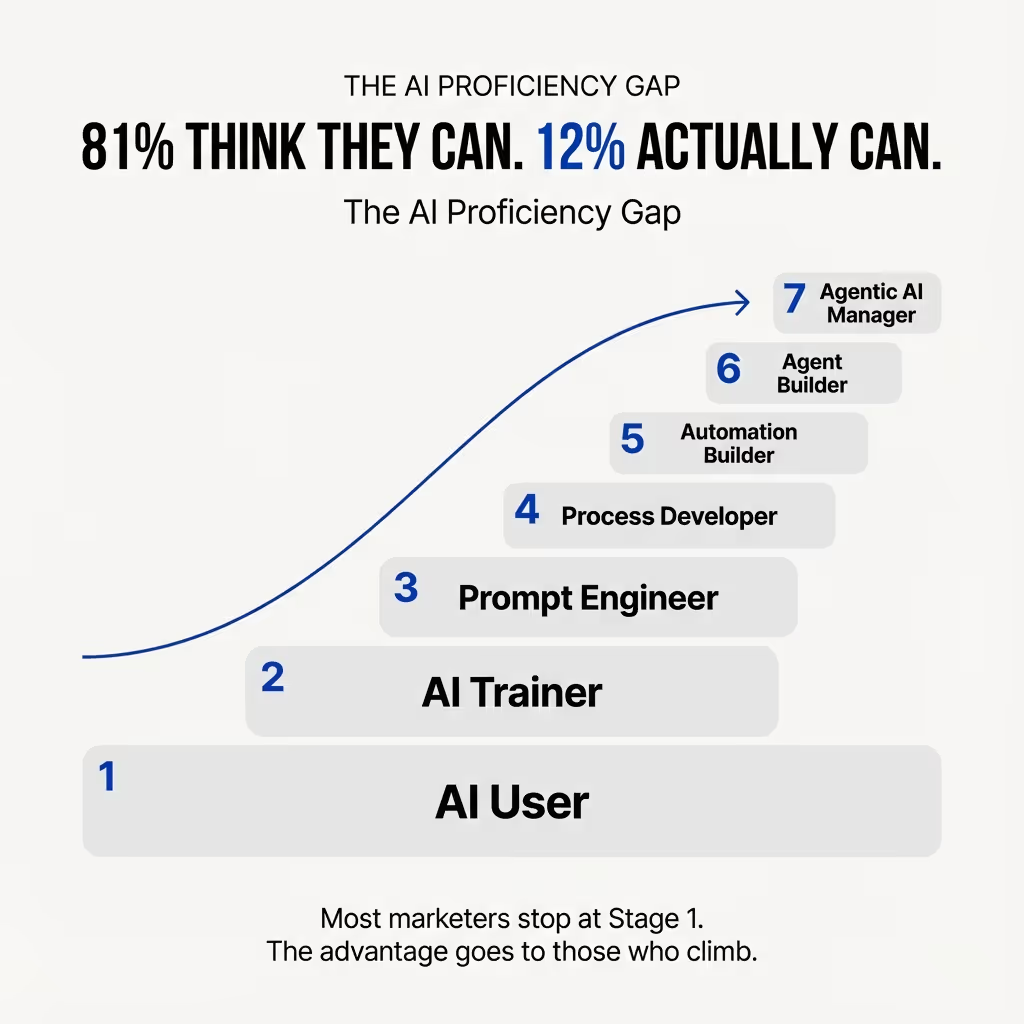
81% of professionals believe they can use AI effectively. Only 12% actually possess the skills to do it well. That gap tells you everything you need to know about where we are right now. The problem is structural, and it reveals itself in how people think about AI proficiency. Most marketers treat AI like a tool you learn once. You figure out ChatGPT, write better prompts, and call it done.
That's stage one thinking. There are six more stages after that.
The framework I'm using here is adapted from Andy Crestodina's "The 7 Stages of AI Proficiency". I've seen these stages play out across hundreds of marketing teams, and the pattern holds. Understanding where you are on this progression determines what you should focus on next.
Stage 1: The AI User
This is where everyone starts. You open ChatGPT, type a prompt, get a response, and move on with your day. The interaction is transactional. You ask, it answers, the conversation ends.
Here's what I've learned from watching hundreds of marketers at this stage. They treat AI like Google. One question, one answer, no follow up. The output quality depends entirely on prompt quality, and most prompts are terrible. You're operating in what I call single moment interactions. Each prompt exists in isolation. No memory, no context, no continuity. This stage works for basic tasks. It fails the moment you need consistency, depth, or anything that requires the AI to understand your specific context.
Stage 2: The AI Trainer
This is where you start uploading context. You give the AI your brand guidelines, your writing samples, your customer data. The shift here is fundamental. You're no longer asking random questions. You're teaching the AI about your specific situation.
Training data trumps prompt cleverness. An ML model is only as good as the training data you feed it. LLM performance is highly sensitive to choices like example ordering and demonstration quality. Reordering examples can produce accuracy shifts of more than 40 percent. Most marketers skip this stage entirely. They jump from basic prompting to trying to build complex workflows, and they wonder why nothing works. The AI Trainer understands something critical. Context is not optional. It's the foundation everything else builds on.
Stage 3: The Prompt Engineer
Now you're iterating. You write a prompt, evaluate the output, refine the prompt, test again. Prompt engineering improves conversations. It optimizes how you communicate with AI to get better, more consistent results. Workers who engage across seven distinct task types report saving five times as much time as those who use only four. Workers are 33% more productive in each hour they use generative AI. But here's the tension. Individual productivity gains don't automatically translate to organizational value.
90% of super productive workers say AI creates more coordination work between team members. 55% of workers have had to completely redo work that AI started. The system wasn't built to absorb the increased output velocity. You're producing more, but the architecture around you can't handle it.
This is where most marketers get stuck. They optimize their personal workflow without addressing the structural problems that limit what they can actually accomplish.
Stage 4: The AI Process Developer
This stage moves your thinking from human head into system. You stop treating AI as a conversation partner and start treating it as a process component. Process development connects prompts into workflows. You're designing how work flows without constant human intervention. The AI and agentic tools market is currently in stage four of maturity. The infrastructure exists to build real processes, and the organizations that figure this out first are gaining structural advantages.
Only about a third of B2B organizations have implemented agentic AI at scale. Those that have report cleaner execution, more predictable contribution to revenue, and better alignment across marketing and sales. The gap between stage three and stage four is massive. Stage three is about personal productivity. Stage four is about organizational capability.
You're building systems, not just using tools.
Stage 5: The Automation Builder
Now you're creating custom AI tools. You're building automations that other people can use without understanding how they work. This involves building custom GPTs or workflow integrations. The destination transitions from isolated AI interactions to workflow fabric that runs through your entire operation. Repeatable workflows matter more than individual tool features. The value is in portability and consistency, not in having access to the latest AI model.
I've seen marketers at this stage replace entire software subscriptions with custom automations. The economics shift dramatically when you can build exactly what you need instead of paying for bloated platforms. The skill requirement jumps here. You need to understand both the marketing problem and the technical architecture well enough to connect them.
Stage 6: The Agent Builder
This is where AI starts operating independently. You're deploying agents that complete tasks online without human supervision. Customer interactions automated by AI agents will grow from 3.3 billion in 2025 to more than 34 billion by 2027. That's a 10x increase in two years. The agentic AI market is exploding from $7.06 billion in 2025 to over $93 billion by 2032. More than 44% growth annually.
The real money is already moving. Salesforce's Agentforce hit $500M in annual recurring revenue. Meanwhile, Microsoft quietly cut their AI sales targets from 50% to 25%. That divergence tells you something. Generic AI tools are struggling. Purpose built agent systems are winning. 33% of enterprise software applications will incorporate agentic AI by 2028, up from less than 1% in 2024. This will enable 15% of day to day decisions to be made autonomously. The acceleration reveals infrastructure maturity. Systems are now capable of handling the architectural complexity that stalled earlier implementations. Agent builders understand something the earlier stages miss. AI proficiency creates structural advantage, not just tactical edge.
When AI is used within the boundary of its capabilities, it improves worker performance by nearly 40%. When used outside that boundary, performance drops by 19 percentage points. Proficiency is about diagnostic clarity regarding where AI applies. You're not using AI more. You're using it better.
Stage 7: The Agentic AI Manager
The final stage is managing teams of AI agents. You're overseeing multiple agents that work together to accomplish complex objectives.
96% of enterprises are expanding their use of AI agents. 83% of executives consider investment in agentic AI essential to stay competitive. Employees saving 10+ hours per week consume 8x more AI credits than casual users. The pattern is clear. Depth of integration matters more than breadth of access. This stage requires a complete shift in how you think about work. Job ownership replaces prompt based interaction. You're not asking AI to do tasks. You're delegating entire functions to systems that operate continuously. The marketers who build AI agents today will manage them tomorrow. The opportunity to develop these skills is available right now, but the window is closing.
In 2023, 47% of organizations cited lack of clear strategy as their biggest AI challenge. By 2024, this dropped to 29%. Organizations are moving from tactical experimentation to strategic implementation. The ones who figure out stage seven first will have advantages that compound over time.
The Real Problem
59% of marketers feel overwhelmed by AI. 75.8% identify AI expertise as a major skills gap. Only 10% of marketers self report highly advanced AI maturity. This is a leadership problem, not a skills problem. The structural truth is there's a significant gap between individual enthusiasm for AI and organizational readiness. While AI adopters see nearly 5x higher labor productivity, 40 to 50% of executives call lack of talent a top AI implementation barrier. The barrier is architectural. Organizations are trying to bolt AI onto existing processes instead of rebuilding the processes around what AI makes possible.
79% of companies are expanding AI adoption in 2025. But expansion without architecture just scales the dysfunction. Awareness without anchored workflow creates temporary productivity loss. You know AI can help, but you haven't built the systems to capture that value consistently. The path forward is clear. Start at stage one, but don't stay there. Move deliberately through each stage, building the foundation before you try to construct the next level.
Complexity is optional. Simplification creates clarity. The marketers who understand this will build systems that work. The ones who don't will keep chasing tactics that produce inconsistent results.
You're either building the architecture now, or you're falling behind someone who is.
Stay in Rhythm
Subscribe for insights that resonate • from strategic leadership to AI-fueled growth. The kind of content that makes your work thrum.
More from Thrum
Additional pieces exploring adjacent ideas