

Four Questions Every Clinician Should Ask Before Adopting an AI Tool in Their Practice
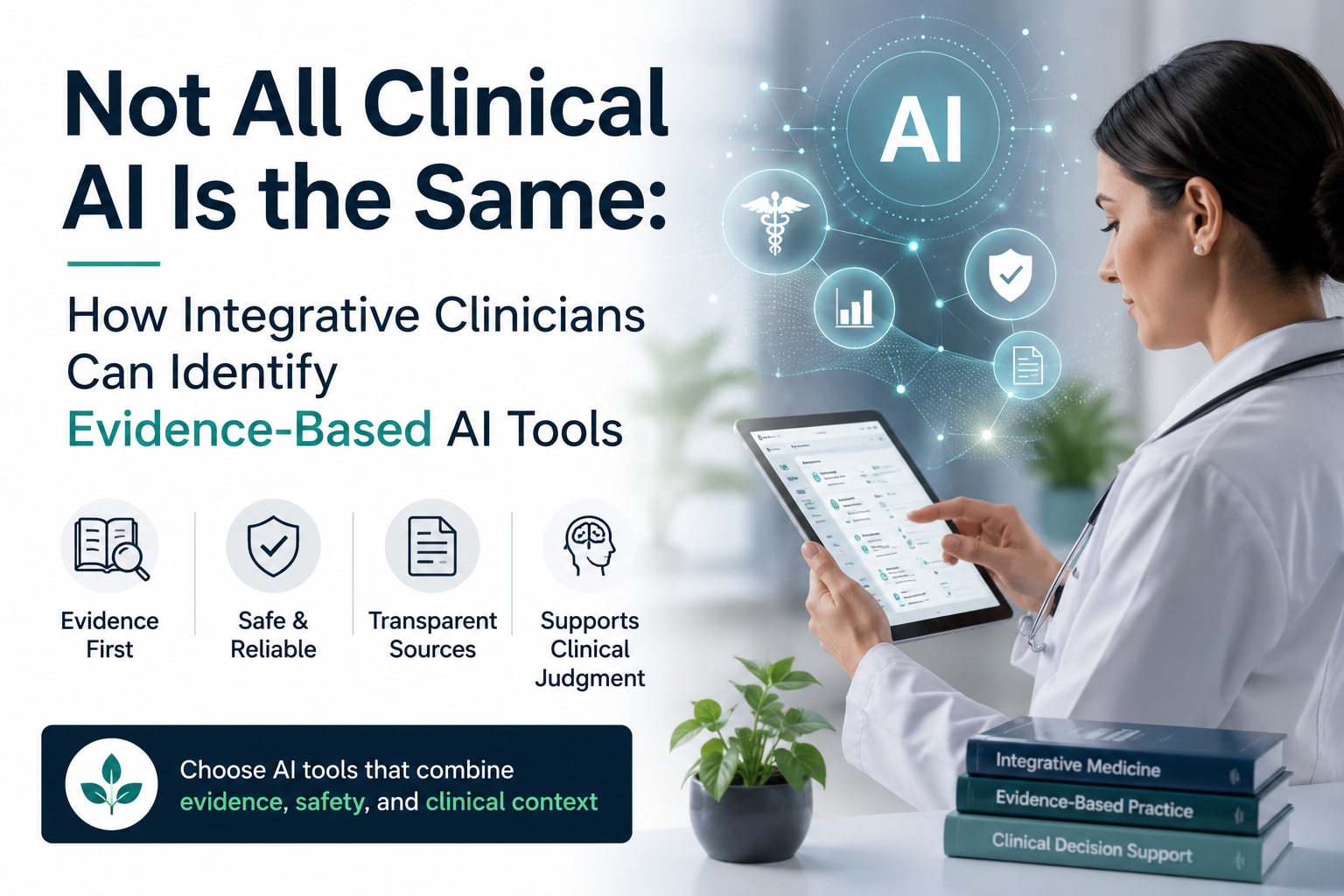

Not every AI tool that markets itself to clinicians was actually built for clinical work — and using the wrong one is a patient safety issue, not just an inconvenience.
That’s the core argument behind a new framework for evaluating clinical AI tools, particularly for integrative and functional medicine practitioners whose workflows differ significantly from conventional medicine. Most large language models are trained on broad internet data — useful for summaries and email drafts, but unreliable for nuanced clinical decisions involving supplement interactions, complex medication regimens, or protocol building.
The Four Questions That Matter
Before adopting any AI platform in clinical practice, the framework recommends asking:
- Where does the knowledge base come from, and who reviewed it? There’s a meaningful difference between AI trained on general web content and AI built on clinician-reviewed monographs. Vague answers to this question are a red flag.
- Does it check drug-nutrient and drug-botanical interactions automatically? This should be part of the core workflow — not an optional step — especially for patients on complex supplement and medication regimens.
- Are recommendations graded by evidence level, with sources cited? AI that produces recommendations without citations is asking clinicians to accept outputs on faith. Evidence grading is non-negotiable.
- Can the output be edited before it reaches the patient? Clinical AI should generate a starting point, not a final answer. Tools that make review and customization difficult aren’t designed with clinical responsibility in mind.
Key Takeaways
- General-purpose AI creates real risk when applied to clinical decision-making.
- Purpose-built clinical AI compresses protocol-building time without sacrificing rigor.
- The right tool acts as a research and formatting assistant — not a replacement for clinical judgment.
🔗 Read the full article on vocal.media
Stay in Rhythm
Subscribe for insights that resonate • from strategic leadership to AI-fueled growth. The kind of content that makes your work thrum.
More from Thrum
Additional pieces exploring adjacent ideas