
From Automation to Augmentation: How Generative AI Is Redefining HR's Future
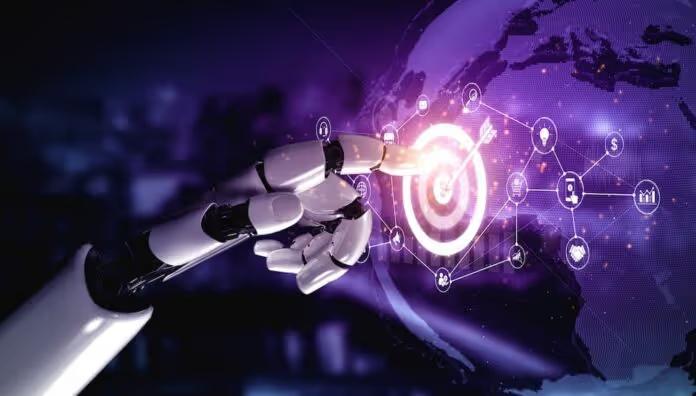

Generative artificial intelligence has moved decisively beyond experimental phases into the core of HR operations, fundamentally reshaping how organizations attract talent, engage employees, and build future-ready workforces. Rather than replacing human judgment, generative AI is enabling HR leaders to operate with greater precision, empathy, and strategic foresight.
According to Mahmood Ahmed Khan, founder of Global HR Management Services, "At its core, generative AI is not about doing HR faster—it is about doing HR smarter."
The Strategic Evolution of HR
HR has always balanced people, processes, and performance, but today's challenges are increasingly complex. Hybrid work models, global talent pools, skills shortages, and rising employee expectations are forcing HR to evolve from an operational function into a strategic nerve center. Generative AI is emerging as a powerful ally in this transformation, enhancing decision-making while preserving the human essence of HR.
Intelligent Precision in Talent Acquisition
Recruitment, traditionally one of HR's most time-intensive functions, is experiencing dramatic transformation through generative AI. The technology brings intelligence, speed, and personalization to every hiring stage:
- AI-powered job descriptions craft inclusive, compelling role postings automatically
- Resume screening processes thousands of applications within seconds while reducing unconscious bias
- Interview optimization generates tailored questions based on specific role requirements and competency frameworks
Real-world impact: A multinational technology firm using generative AI to analyze past hiring success and generate role-specific competency frameworks achieved a 35% reduction in time-to-hire while significantly improving quality-of-hire scores within six months.
Continuous Employee Engagement and Experience
Traditional annual surveys and delayed feedback systems are being replaced by continuous, real-time employee sentiment analysis. Advanced language models analyze employee feedback, internal communications, and engagement surveys to identify emerging concerns, morale trends, and cultural gaps long before they escalate into attrition risks.
AI-enabled HR chatbots provide employees with instant, consistent responses to policy questions, benefits inquiries, and career guidance—enhancing both accessibility and organizational trust.
Personalized Learning at Enterprise Scale
Generative AI dismantles the one-size-fits-all approach to employee development by enabling hyper-personalized learning journeys. By analyzing skills data, performance metrics, and career aspirations, AI generates:
- Customized training content tailored to individual needs and learning styles
- Real-world scenario simulations for practical skill development
- Learning pathway recommendations aligned with both individual goals and organizational objectives
Case study: A global manufacturing company's AI-driven learning assistants create personalized upskilling plans for frontline managers, leading to higher course completion rates and measurable improvements in leadership effectiveness.
Workforce Planning and Strategic Decision-Making
The most transformative impact lies in workforce planning capabilities. By combining historical data with predictive modeling, HR leaders can simulate future scenarios including skills shortages, workforce costs, and succession risks before they become critical challenges.
Ethics and Responsible AI Implementation
The adoption of generative AI in HR must be grounded in transparency, fairness, and ethical governance. Clear policies, human oversight, and bias audits are essential to ensure AI augments rather than undermines organizational trust. HR leaders are uniquely positioned to champion responsible AI use, setting standards that align technology with organizational values.
As Khan notes, "The true competitive advantage in an AI-driven HR function lies not in automation alone, but in how effectively organizations amplify uniquely human capabilities."
🔗 Read the complete analysis: From Automation to Augmentation: How Generative AI Is Redefining the Future of HR
Stay in Rhythm
Subscribe for insights that resonate • from strategic leadership to AI-fueled growth. The kind of content that makes your work thrum.
More from Thrum
Additional pieces exploring adjacent ideas